
Modern infrastructure teams are expected to deliver cloud-like speed, consistency, and reliability, even when their workloads run on physical servers. Bare metal remains essential for many environments: private clouds, Kubernetes clusters, AI infrastructure, edge sites, regulated platforms, and large Ubuntu estates. But operating physical
A platform is an environment that allows software to run smoothly across the infrastructure, runtime, and application layers. The key word there is “smoothly”: a good platform connects those layers so well that you don’t notice it. That’s what Ubuntu Server has become: the essential layer between bare metal and the apps running on top,
Canonical is pleased to share its latest research report, “The open source chain of trust.” Based on a survey of 500 DevOps professionals, the report highlights how organizations approach their open source software supply chains. While many companies are moving toward verifiable provenance and automated security workflows, internal misali
In the traditional automotive world, teams often work in silos: the cybersecurity experts lock down the ports, the quality assurance teams hunt for bugs, and the functional safety engineers track the ISO 26262 compliance. At Canonical, we believe this fragmented workflow causes friction rather than collaboration.
On June 25, 2026, JFrog published their research into CVE-2026-43503, referring to the vulnerability as DirtyClone. The vulnerability had previously been responsibly disclosed to the Linux kernel maintainers and the CVE record published on May 23, 2026. The vulnerability affects multiple Linux distributions, including all Ubuntu releases.
Mitigations are available for the Linux vulnerability with CVE ID CVE-2026-46331. The CVE ID was assigned on June 16 2026 and highlighted as a local privilege escalation (LPE) vulnerability on June 26, 2026. Known as “pedit COW”, this vulnerability affects multiple Linux distributions, including all Ubuntu releases starting with Bionic Be
Canonical is pleased to announce it is now a Gold Sponsor of the Trifecta Tech Foundation, a non-profit that creates open source building blocks for critical infrastructure software. Canonical has supported the foundation’s work since 2025, co-sponsoring the development of projects like sudo-rs. The new €40,000/year contribution will hel

Open source powers up to 90% of modern software, yet many projects lack usability. Canonical’s Design team surveyed 115 cross-functional professionals to uncover the 4 core challenges UI/UX designers face when contributing, and how maintainers can solve them.

Newsletter signup
This article was written by Marco Manino and Alberto Carretero, dqlite team at Canonical. 1. Anatomy of a SQLite bug Recently SQLite published a new version with a fix to a long-standing bug in the way that the Write Ahead Log (WAL) is checkpointed that leads to the corruption of the database. The important aspect
Why C4A metal is a great place to run Android and why Anbox Cloud makes that practical. If you’ve spent even a small portion of time working with Android development at scale, you’ve likely encountered some pinch points. The platform was built for Arm-based devices, mobile physical hardware, and tightly controlled system environments. Clo
Canonical Livepatch now officially supports Arm64, further expanding its security patching automation capabilities. For the first time, Ubuntu on an Arm64 machine can apply critical kernel updates, without service interruption or rebooting. Starting with Ubuntu Core 26 for Arm64, and for Ubuntu Core 20 and onwards for AMD64 machines, a wi
Introduction My previous blog talked about the importance of instruction set standardization for ecosystem stability and growth through the use of profiles. And standardization is indeed important, but since one of RISC-V’s great benefits is the ability to customize the instruction set, we should also consider how to support that ability.
What an incredible experience! Ubuntu Summit 26.04 has officially drawn to a close, but the energy from our global community is still buzzing – in the comments section, on social media, and in news reports. Whether you joined us in person or tuned in from across the globe, you helped make this edition our most

Your Ubuntu Core fleet is running beautifully. OTA updates roll out in minutes. Every device is strictly confined, cryptographically attested, and carrying a 10 to 15 year long term support (LTS) commitment. The operational team sleeps soundly. Then the product roadmap meeting happens. The industrial floor needs vibration sensors on every

In an increasingly volatile job market, standing out from the competition is vital. For many in the open source community, formal recognition for self-taught skills is a significant challenge. These skills are often built through hands-on hobbies, side projects, and deep community contributions. While the market is flooded with certificat
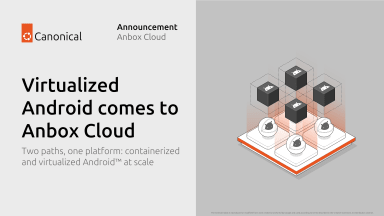
With our latest 1.30.0 Anbox Cloud release, available today, we are introducing one of the most significant evolutions of the platform to date: support for virtualized Android. For the first time, Anbox Cloud can launch complete Android system images inside lightweight virtual machines, managed and orchestrated through the same Anbox API
Ubuntu tech blog
Deep dives for developers
Visit the Ubuntu Tech Blog for deep dives into product features, step-by-step tutorials, and the latest updates from Canonical's engineering teams.